

Donate

Donate Tree or Seeds or E-waste
Our Company Address
Green Future Foundation
123 Nature Avenue,
Eco City, Green State 123456,
India
Email: contact@greenfuture.org
Phone: +91 9876543210
Ocean Current Research
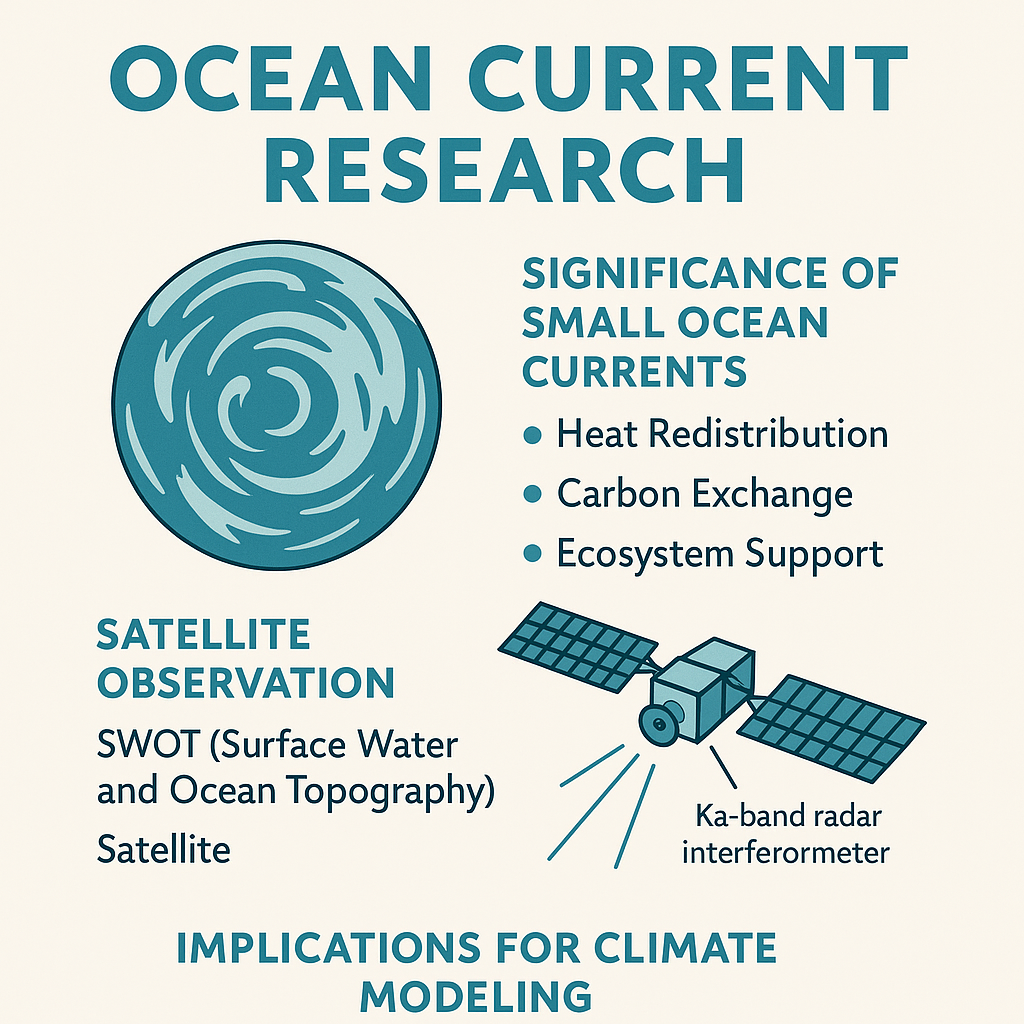
Recent research has unveiled the significant role that small ocean currents, known as eddies, play in Earth's climate system. These swirling water masses, often spanning less than 200 kilometers, are crucial in regulating heat distribution, carbon exchange, and marine ecosystems.
🌊 Key Findings on Small Ocean Currents
Heat Redistribution: Eddies facilitate the transfer of heat between the ocean's surface and deeper layers, influencing global weather patterns and events like El Niño and La Niña.
Carbon Exchange: These currents significantly impact the ocean's ability to absorb or release carbon dioxide (CO₂), with some regions experiencing up to a 30% variation in CO₂ exchange due to eddy activity.
Ecosystem Support: By transporting nutrients and supporting marine life, eddies contribute to the health and productivity of ocean ecosystems.
🛰️ Technological Advancements
The Surface Water and Ocean Topography (SWOT) satellite, launched through a collaboration between NASA and international partners, has provided unprecedented insights into these small-scale ocean features. Equipped with a Ka-band radar interferometer, SWOT measures minute changes in sea surface height, revealing previously unseen oceanic structures.
🔍 Implications for Climate Modeling
Understanding the dynamics of small ocean currents is essential for improving climate models and predicting future climate scenarios. As global temperatures rise, the behavior of these currents may change, potentially altering their role in heat and carbon distribution. Ongoing research aims to integrate these findings into comprehensive climate models to enhance predictive accuracy.
Here are some frequently asked questions (FAQs) related to ocean current research, particularly focused on recent findings and their implications:
---
🌊 General Understanding
1. What are ocean currents?
Ocean currents are continuous, directed movements of seawater generated by various factors such as wind, Earth’s rotation (Coriolis effect), salinity differences, and temperature gradients. They occur at both surface and deep ocean levels.
2. What are eddies in the ocean?
Eddies are small, circular currents of water, typically under 200 km in diameter. They form from large-scale currents and play a vital role in transporting heat, nutrients, and carbon.
---
🔬 Scientific Significance
3. Why are small ocean currents important in climate research?
Small ocean currents (eddies) regulate how oceans absorb and release heat and CO₂. They influence weather patterns, marine biodiversity, and global climate stability.
4. How do ocean currents affect the Earth’s climate?
They distribute heat around the globe, regulating temperatures and influencing climate patterns like the Gulf Stream warming Western Europe or the El Niño–Southern Oscillation impacting global rainfall and droughts.
---
🛰️ Technology and Observation
5. How are ocean currents studied?
Researchers use a combination of satellite data (like SWOT), underwater floats (e.g., Argo), ships, and computer models to study ocean current patterns and properties.
6. What is the SWOT satellite and how is it used in ocean research?
The Surface Water and Ocean Topography (SWOT) satellite is a joint mission by NASA and global partners. It uses radar interferometry to map sea surface heights with high precision, helping scientists detect small currents and eddies.
---
🌱 Environmental Impact
7. Do ocean currents influence marine ecosystems?
Yes. Currents carry nutrients essential for phytoplankton growth, which supports marine food chains. Eddies in particular are known to create nutrient-rich zones that boost biological productivity.
8. How might climate change affect ocean currents?
Rising temperatures and melting ice can alter ocean salinity and temperature gradients, potentially weakening major currents like the Atlantic Meridional Overturning Circulation (AMOC), which could drastically affect global climate.
---
📈 Future Directions
9. What are researchers currently focusing on in ocean current studies?
Scientists are investigating how small-scale currents influence global climate models, CO₂ cycles, and marine heatwaves. They’re also exploring how these dynamics may shift with climate change.
10. How does this research help us?
Better understanding of ocean currents improves weather forecasting, climate modeling, disaster preparedness (like predicting El Niño), and marine conservation strategies.
Search
Categories
Tags
Latest Article